
IQ Persona allows you to access 12 personas - examples include Fans, Destination Weekenders, High Spenders, or Community Access. Personas are created per experience so that every production can understand who is attending, how they behave, and how best to communicate with them.
Why this could benefit your organisation:
-
Smarter marketing - tailor your messaging and creativity to each segment rather than broadcasting to your full list.
-
Improved ROI - stop under-pricing to high spenders, connect these audiences with premium seating and packages.
-
Arts Council England aligned reporting - Community Access is built on ACE's own priority places logic, making funding narratives straightforward to evidence whilst allowing you to connect communities and individuals who often have less access to the arts with accessible price points and supporting schemes.
-
Catchment intelligence - understand whether you're drawing locally, regionally, or as a destination, and market accordingly.
-
Production-by-production insight - personas adapt per show, so a pantomime and a contemporary dance piece are segmented on their own terms.
-
CRM activation - segments plug directly into email, paid, and social targeting without manual list-building. Ready to supercharge your marketing!
You can access IQ Persona under Analytics > IQ Persona. Simply adjust your date filter to find the insights based on specific periods or all time direct sales.
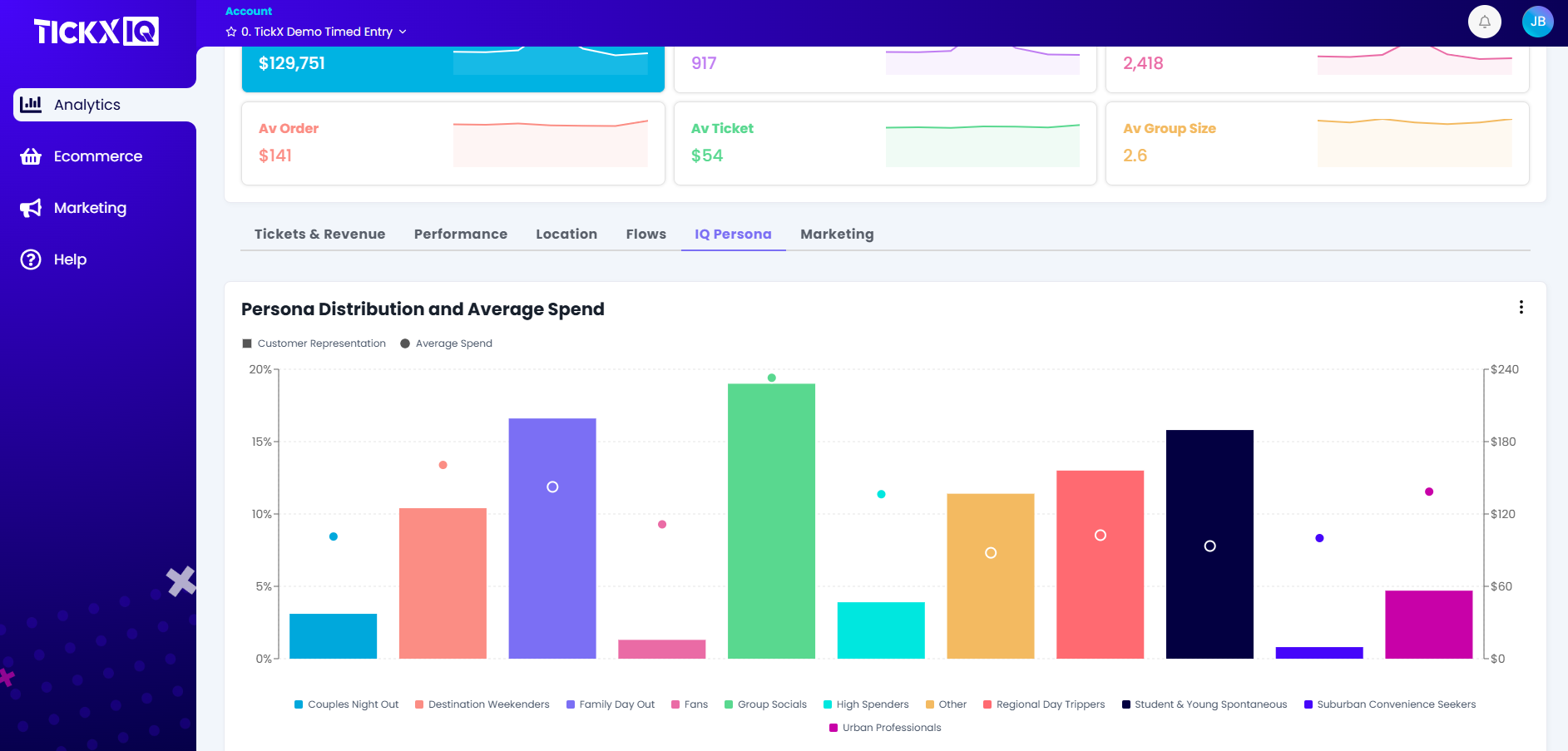
How each persona is generated and tips on how to communicate to these specific audiences.
This product delivers clear, actionable audience segmentation for theatres, shows, and attractions, combining ONS demographic context with first-party transactional behaviour. Personas are created per show (widget) so that every production can understand who is attending, how they behave, and how best to communicate with them.
The segmentation is designed for use across:
- Analytics (audience mix, reach, performance benchmarking)
- Marketing & CRM activation (targeting, messaging, channel strategy)
- Public funding & impact reporting, including Arts Council England (ACE) narratives around access and engagement
The output is a single, unified segment per customer per show, avoiding fragmented or overlapping classifications which can easily be integrated into the IQ infrastructure
Data Sources
1. First-party transactional data
Used to understand behavioural intent.
- Orders and tickets
- Spend and average ticket price
- Booking lead time (days to purchase)
- Visit timing (weekday/weekend, daytime/evening)
- Travel distance from customer location to venue
2. ONS Census 2021 (LSOA level)
Used to understand local demographic context.
- Age structure
- Student prevalence
- Household composition
- Tenure (owner / private rent / social rent)
- Occupation profile
- Car availability
3. Index of Multiple Deprivation (IMD – England)
Used to identify structural barriers to participation.
- IMD deciles (small-area deprivation)
- Domain-level indicators (income, employment, education, health, etc.)
4. ONS LSOA → Local Authority District (LAD) lookup
Used to compute place-based deprivation concentration, aligned with ACE methodology.
Key Feature Engineering
Behavioural features (per show)
These are calculated relative to each widget, ensuring Personas adapt to different price points and audience norms.
- Spend band: customer spend percentile within the show
- Price band: average ticket price percentile
- Lead time band: booking earliness (planner vs spontaneous)
- Basket type: solo, couple, group, family
- Distance band: local / regional / destination
Contextual features (absolute thresholds)
These are not account-relative, ensuring meaning stays consistent across shows.
- Student-heavy areas
- Family-heavy areas
- Professional vs routine occupations
- Car ownership vs car-free urban areas
ACE-Aligned Community Access Methodology
Community Access is defined using an approach closely aligned with Arts Council England’s “priority places” methodology.
Rather than relying only on an individual postcode’s IMD score, the model identifies:
- Individual deprivation – customers living in LSOAs in the bottom two IMD deciles, and
- Place-based deprivation – customers living in local authorities with a high concentration of bottom-decile LSOAs
This mirrors ACE’s approach of avoiding “masking” of high-need communities and ensures that Community Access represents England-wide structural barriers, not just hyper-local effects.
A proxy using tenure and car access is applied for non-England customers where IMD is unavailable.
Reference: ACE Methodology for Identifying Priority Places
The Personas
Fans (repeat purchasers)
How it’s defined:
Customers with 2+ orders (orders >= 2), regardless of distance, timing, or price.
Who they represent: Your “already converted” audience—people who’ve come back (or bought again) because the product/venue clicked. They’re the closest thing to a membership mindset without being members.
How to communicate: Treat them like insiders. Prioritise early access, “first to know” comms, loyalty perks, and new dates/added performances messaging. Use personalised recommendations (“based on what you saw…”) and frictionless rebooking.
Destination Weekenders
How it’s defined: Far travel (≥140km) + weekend visit + 2+ tickets, plus at least one “destination” signal: early planners, premium price, or group behaviour.
Who they represent: People making a trip out of it—mini-break energy. They’re planning ahead, more willing to pay, and likely bundling the experience with dining, hotels, or other attractions.
How to communicate: Sell the occasion. Lead with limited availability, best slots, and “make a weekend of it” framing. Provide clear planning cues (timings, venue info, nearby recommendations) and nudge premium inventory (best seats/peak slots).
Community Access
How it’s defined: A customer is eligible when they sit in the top ~8% of “need” (deprivation / access barriers / ACE proxy), and show an opportunity profile: local (≤50km), not premium, low/mainstream price bands, and not a destination-weekender pattern.
Who they represent: Local audiences who are price-sensitive and access-constrained, but still actively choosing cultural/leisure experiences when the offer feels doable.
How to communicate: Emphasise accessibility, clarity, and reassurance: simple pricing, “what’s included”, easy arrival info, family-friendly practicalities. Use community channels and partners, avoid luxury language, and message value + welcome rather than discounts as a headline.
Family Day Out
How it’s defined: Primarily appears when the show behaves as family-led (high share from family areas + group/daytime patterns), and the customer is group 3+ with daytime/weekend timing. Also includes a secondary route for adult-led shows: 4+ tickets, strong family area, daytime. Guardrail: if ticket price is ≥ p60, you reassign to Group Socials.
Who they represent: Parents/guardians organising a dependable plan. They want low stress, predictable logistics, and something that feels “worth it” for the whole group.
How to communicate: Focus on practical confidence: duration, entry windows, facilities, accessibility, “what to expect”, and easy group booking. Family value cues work best (bundle language, “kids will love…”, clear age suitability). Reduce uncertainty and decision load.
Regional Day-Trippers
How it’s defined: Mid distance (50–140km) + weekend or daytime, and not super last-minute (lead is early or mid).
Who they represent: People in the wider catchment treating the experience as a half-day/day plan—often combining with shopping, lunch, or another stop. Less “weekend away”, more “nice day out”.
How to communicate: Lean into itinerary-friendly messaging: “perfect for a day out”, parking/transport clarity, nearby suggestions, and timed-entry convenience. Retarget with weekend slots and “plan ahead” nudges. Use scarcity lightly (“popular time slots go first”).
Suburban Convenience Seekers
How it’s defined: Close (≤50km) plus area signals of suburban living: owner-heavy or multi-car households.
Who they represent: Local-ish, convenience-led customers. They’ll come if it fits into life easily—low hassle beats novelty. Often organised schedules, driving likely, and responsive to clear options.
How to communicate: Make it effortless: simple booking UX, “easy parking”, “arrive any time in your window”, clear directions, fast FAQs. Messaging that highlights low friction and dependable enjoyment outperforms brand poetry.
Student & Young Spontaneous
How it’s defined: Area looks student-heavy or young adult-heavy, and the booking sits in low or mainstream price bands.
Who they represent: Value-seeking, socially influenced audiences. More likely to decide late, motivated by “what’s on”, and open to trying things when it feels shareable and affordable.
How to communicate: Keep it punchy and social: short-form creative, group prompts (“bring a mate”), clear pricing, and urgency hooks (limited tickets, last-minute slots). Highlight shareable moments and use channels where discovery happens (social, creators, campus/community lists).
Urban Professionals
How it’s defined: Professional-heavy areas plus either no-car urban signals or simply being close (≤50km) while professional-heavy.
Who they represent: Time-poor, experience-rich customers. They’ll pay for quality when the experience feels curated, premium-adjacent, and fits a busy schedule.
How to communicate: Lead with credibility + efficiency: strong reviews, “best time slots”, date-night framing, minimal copy, and clear premium cues (production quality, uniqueness). Conversion improves with calendar-friendly nudges and “book in two taps” simplicity.
Couples’ Night Out
How it’s defined: Couple party size (as per your current metric) and evening entry (≥18:00).
Who they represent: A classic “occasion slot” segment—people buying a shared evening experience. Often motivated by novelty, romance, or a reliable plan that feels special.
How to communicate: Use date-night language: ambience, “perfect evening plan”, add-ons (bar, nearby dinner), and premium time-slot cues. Retarget with evening availability and “last few” inventory prompts.
Group Socials
How it’s defined: Group 3+, not Family Day Out, and either the show is adult-led or it’s not daytime. This becomes a catchment for social occasions that aren’t explicitly family-led.
Who they represent: Friends, birthdays, colleagues—people organising a shared plan. They care about coordination, ease of booking together, and “this will be fun” reassurance.
How to communicate: Make group organising painless: group booking CTAs, “choose your time window”, flexible entry, and prompts like “perfect for birthdays”. Messaging that helps the organiser look good wins: “easy to plan, everyone will enjoy it.”
High Spenders
How it’s defined: Anyone in the premium price bands (High/Very High) who hasn’t already been captured by an earlier, more specific segment.
Who they represent: Value-through-quality audiences: they’re paying for the best version—best seats, best slots, best experience, or simply status/occasion value.
How to communicate: Don’t talk discounts. Talk experience quality, exclusivity,peak slots, and “best available”. Use premium cues, elevated creative, and upsell paths (VIP, add-ons, upgrades).
Other
How it’s defined: The remainder after applying all rules.
Who they represent: Mixed behaviours—often “default local buyers”, edge cases, or customers missing key signals (no LSOA match, ambiguous party size, etc.).
How to communicate: Use this as your testing pool: broad creative, lightweight personalisation (timing/price), and let response data guide whether you carve out another formal segment later.
Summary
This segmentation framework balances:
- Behavioural truth (how people actually attend),
- Demographic context (who they are and where they live), and
- Policy relevance (ACE-aligned access narratives),
Resulting in Personas that are:
- Stable across productions
- Actionable for marketers
- Defensible for reporting and funding contexts
For more information please contact your Account Manager.