
This guide explains how the Marketing Channel Performance section in TickX IQ uses UTM parameters and last-click attribution to categorise traffic sources and measure the effectiveness of your marketing activity. It outlines how channels are mapped, how orders and revenue are attributed, and how to interpret key metrics such as order mix, revenue mix, AOV, sources, and campaign performance. The guide helps you understand which channels close the final sale, how individual campaigns contribute to revenue, and how to use these insights to optimise budget allocation, improve campaign performance, and strengthen your overall marketing strategy.
Getting Started with Marketing Sales Reporting
The Marketing Channel Performance section of your TickXIQ dashboard provides valuable insights into how your marketing efforts are performing across different channels. This tool uses UTM parameters and last-click attribution to map and categorise traffic sources, helping you evaluate the effectiveness of your marketing strategies and optimise for better results. Click here to see UTM Parameter usage recommendations.
Introduction to UTM Parameters and Last-Click Attribution
UTM Parameters are tags added to the end of URLs in your marketing campaigns. These parameters help track the effectiveness of digital marketing efforts by identifying the source, medium, campaign, content, and term associated with the traffic coming to your site.
For example:
- Source might indicate the website or platform (e.g., "Google," "Facebook").
- Medium describes the type of traffic (e.g., "Paid Social," "Email").
- Campaign identifies a specific marketing effort (e.g., "Spring_Sale").
Last-Click Attribution is a model used to attribute the entire value of a conversion to the last marketing channel or touchpoint the customer interacted with before making a purchase. This model is beneficial for understanding which channels directly lead to sales.
How Marketing Channel Performance is Mapped
In the Marketing Channel Performance section, the TickXIQ dashboard maps your channels based on the last-click UTM parameters. This mapping allows you to see how different channels contribute to overall sales performance. The channels are categorised into various types, such as:
- Paid Social (e.g., Facebook, Instagram ads)
- Email (e.g., newsletters, promotional emails)
- Direct (e.g., direct visits to your website without referral)
- Display (e.g., banner ads, display networks)
- Google Paid (e.g., Google Ads)
Understanding the Marketing Channel Performance Metrics
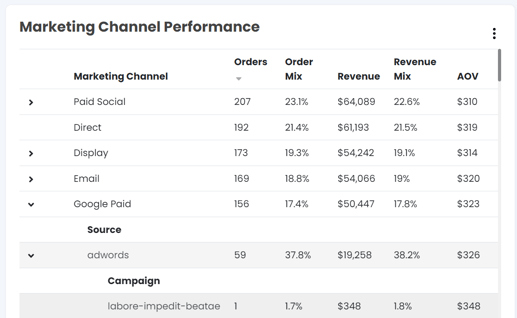
-
Marketing Channel Overview
- The main table displays the performance of each marketing channel. It breaks down key metrics such as:
- Orders: Total number of orders attributed to each channel.
- Order Mix: The percentage of total orders generated by each channel.
- Revenue: The total revenue attributed to each channel.
- Revenue Mix: The percentage of total revenue generated by each channel.
- AOV (Average Order Value): The average revenue per order for each channel.
- How to Use:
Use this overview to quickly understand which marketing channels are driving the most orders and revenue. Identify high-performing channels and allocate more resources to them, or investigate underperforming channels to optimise and improve their effectiveness.
- The main table displays the performance of each marketing channel. It breaks down key metrics such as:
-
Source and Campaign Details
- The table also provides deeper insights by breaking down each marketing channel into its associated Source and Campaign:
- Source: Details the specific origin of traffic within a marketing channel (e.g., "meta" under Paid Social).
- Campaign: Shows the performance of individual campaigns under each source, including the number of orders, revenue generated, and average order value.
- How to Use:
Examine the performance of specific sources and campaigns to understand which are most effective. For example, you might find that a particular campaign under the "Paid Social" channel is generating a high revenue but has a low order volume, indicating high-value purchases from a smaller customer base.
- The table also provides deeper insights by breaking down each marketing channel into its associated Source and Campaign:
-
Mapping Marketing Channels
- Channels are mapped based on the last-click UTM parameters, allowing you to see the final touchpoints that lead to conversions.
- How to Use:
By focusing on last-click attribution, you can determine which channels and campaigns are most effective at converting leads into customers. This insight helps in fine-tuning your marketing strategy to focus on channels that close the deal.
Benefits of Using Marketing Channel Performance Insights
- Optimise Marketing Spend: Identify which channels provide the best return on investment (ROI) and allocate your budget accordingly.
- Improve Campaign Effectiveness: Evaluate the performance of specific campaigns to refine and improve future marketing efforts.
- Understand Customer Journeys: Use last-click attribution data to understand the final steps customers take before converting, helping you optimise those final touchpoints.
Conclusion
The Marketing Channel Performance section of your TickXIQ platform offers a comprehensive overview of how your marketing channels are performing based on UTM parameters and last-click attribution. By understanding these metrics and utilising the insights provided, you can make data-driven decisions to enhance your marketing strategies, maximise revenue, and achieve better overall results.